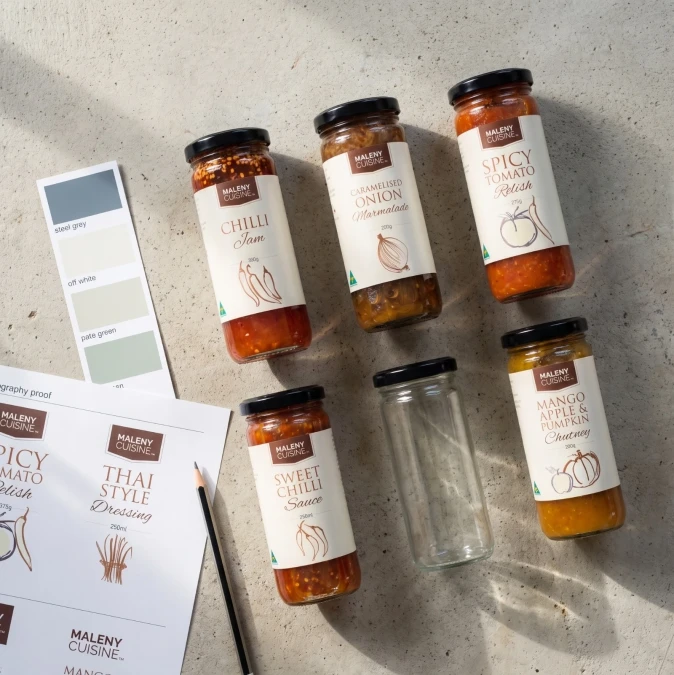
The condiment aisle is one of the strangest places in a grocery store. It is crowded — often three or four bays deep — and yet a surprising share of it moves slowly. Shoppers walk past dozens of jars to reach the two or three they already trust, and the rest sit there earning shelf rent they never quite pay back.
For a buyer, that makes range decisions in this category unusually consequential. A new line does not simply add sales; it displaces something. So the question is never whether a product is nice. It is whether this jar will work harder than the one it replaces.
Here is how we would suggest working through that question, whether you are an independent grocer, a regional wholesaler, a gourmet retailer or a foodservice distributor.
1. Can a shopper read the story in three seconds?
Premium condiments are an impulse-adjacent purchase. Nobody writes caramelised onion marmalade on a shopping list — they see it, they picture it on a cheese board, and it goes in the trolley. That whole decision happens in a few seconds while the shopper is standing side-on to the shelf.
Which means the pack has to do the work. Look at a proposed range the way a distracted customer would. Is the flavour name legible from a metre back? Is the provenance obvious? Does the label look like something you would be happy to put on the table in front of guests, or something you would decant first?
Ranges that carry a visible regional identity tend to outperform generic premium packaging, because the story does double duty — it justifies the price and it gives the shopper something to say when they hand the jar over at a dinner party.
2. Dietary claims that do real work
Not all claims earn their place. Gluten free on a condiment range is one of the few that reliably does, because it changes who can buy the product rather than just how they feel about it.
Coeliac and gluten-sensitive shoppers approach this aisle defensively. Soy-based sauces, malt vinegar and thickened relishes are all common failure points, so these customers read labels closely and remember the brands that pass. A range that is gluten free across the board — not just on two SKUs — becomes a default rather than a considered purchase, and default purchases repeat.
The same logic applies to country-of-origin labelling. Australian Made and Australian Grown claims are increasingly a tiebreaker at shelf, particularly in regional stores where the buying public actively looks for them.
3. Range depth without shelf bloat
There is a temptation, when a supplier presents well, to take the whole catalogue. Resist it. A twelve-SKU listing that averages poor rate of sale is worse for both parties than a six-SKU listing that turns.
A sensible approach is to build around three roles:
- The anchor. One or two flavours that do volume and give the range visibility. In condiments this is usually a sweet chilli, a tomato relish or a barbecue sauce — familiar formats where the shopper is trading up rather than trying something new.
- The signature. The flavour only this supplier has, and the reason a customer comes to your store rather than the supermarket. A chilli jam or a whiskey-spiked conserve does this job.
- The seasonal. Lines that spike hard and predictably — Christmas puddings, gifting packs, summer barbecue formats. These carry the range through the quarters when everything else is flat.
Fill those three roles and you can expand later from actual scan data rather than from a hunch.
4. Supply reliability is the quiet dealbreaker
Every buyer has been burned by this. A range performs, the customer comes back for it, and the third order arrives short. Two months of that and the customer stops asking.
Before listing, ask the unglamorous questions. What is the standard lead time, and what happens to it in November? What are the minimum order quantities, and are they realistic for your store size? Is there a single production site or redundancy? Where do the key raw ingredients come from, and what happened to supply the last time there was a bad season?
A supplier who answers these precisely — with numbers, not reassurance — is telling you something useful about how the business is run.
5. Margin maths beyond the invoice
Cost price is the beginning of the calculation, not the end. Work through the whole picture: case configuration and how it fits your shelf, shelf life on arrival and your write-off risk, whether the supplier funds promotional activity or expects you to, freight to your location, and what the realistic retail price is in your catchment rather than in a capital-city gourmet store.
A range at a slightly higher cost price with strong shelf life, funded promotions and a case size that suits your fixture will often out-earn a cheaper one that ties up capital and generates markdowns.
6. What comes with the pallet
The best supplier relationships include more than product. Point-of-sale material that suits your fixture. Planogram guidance based on what works in comparable stores. Sampling support for launch. Recipe cards or shelf talkers that give the shopper a reason to buy today. Responsive account management when something goes wrong — which it eventually will.
This is where a distribution partner earns its margin. Anyone can put stock on a truck.
Where Niora Foods fits
Niora Foods works across manufacturing, importing, wholesale distribution and brand development — which means when you list one of our ranges, you are dealing with the group that makes it, not a reseller two steps removed from production. Maleny Cuisine, our Sunshine Coast condiment brand, has been made in Queensland since 1988 from seasonal local produce, and the range is gluten free.
For a trade price list, a sample pack or a range recommendation built around your store format, get in touch with our wholesale team. We will start with what your shelf actually needs, not with our full catalogue.